



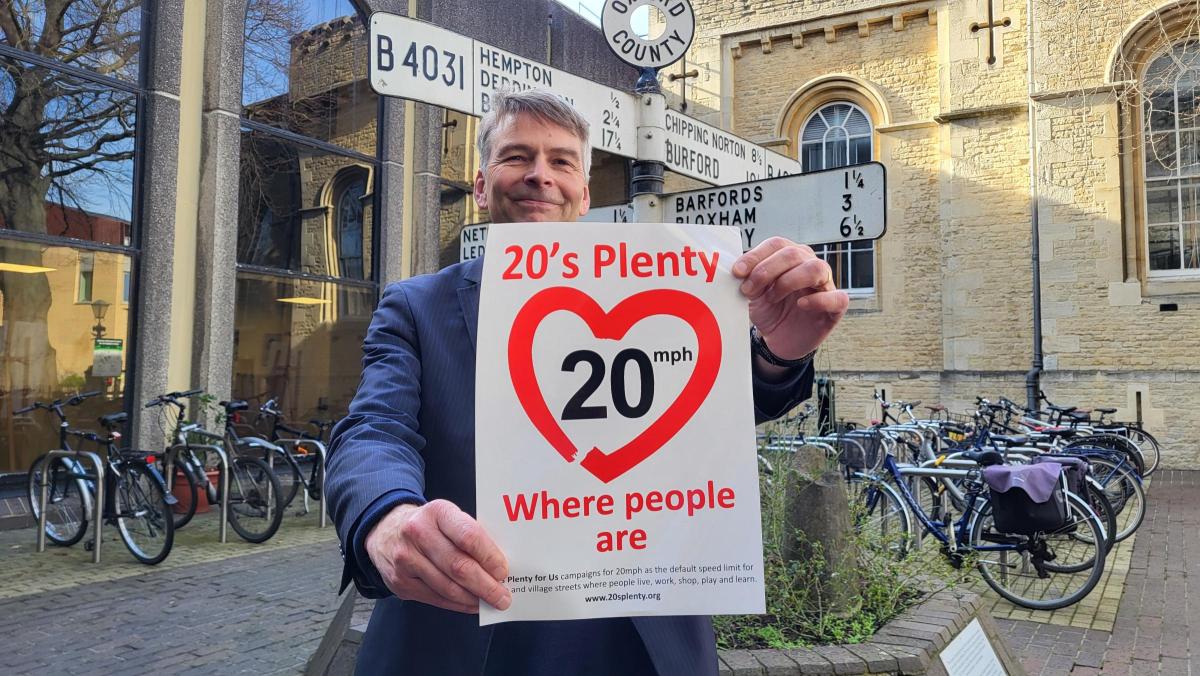

Roads should have to justify retaining 30mph speed limits rather than councils needing to argue for 20mph zones, Oxfordshire's transport boss has told MPs.
Paul Fermer, director of environment and highways at Oxfordshire County Council, said lower speed limits should become the norm as the authority continues its drive towards its Vision Zero ambition of eliminating deaths and serious injuries on the county's roads by 2050.
Giving evidence to Parliament's Transport Committee inquiry into road safety, Mr Fermer said Oxfordshire had been "very successful" in rolling out 20mph limits and claimed there was evidence they had made streets safer.

He told MPs: "We believe that the norm should be 20 mph for urban areas and 50 mph, potentially 40 mph, for rural areas, and that you have to justify as a local authority why it should be higher.
"At the moment we have to justify and have arguments about why we want to make streets 20 mph and not 30 mph. It should be the other way around."
The comments go further than Oxfordshire's existing 20mph programme, suggesting a future where lower limits would become the default position and authorities would need specific justification for allowing faster traffic.
Mr Fermer - who is not an elected official - also revealed the council is reviewing higher-speed roads across the county.
"We are looking at reducing a significant number, if not all of them, down to 50 mph," he said, referring to A and B roads that still have 60mph limits.
He argued that lower speeds save lives and said Oxfordshire's approach was focused on creating "safer streets" as well as safer roads.
The transport chief also suggested technology could play a greater role in tackling speeding in future.
"Vehicles are capable of restricting speed," he said. "Legislatively, you could presumably put in some caps that prevent vehicles from travelling above the speed limit."
He pointed to average-speed camera schemes in Wales as an example of measures that can help improve compliance.
Despite Oxfordshire's investment in road safety, Mr Fermer warned that current funding levels would make it extremely difficult to achieve the county's long-term ambitions.
"We have an ambitious target, which is zero deaths and serious injuries by 2050. Our current trend will not get us there," he said.
"Without significant injection of funding for both us and the police, it will be very difficult, probably impossible, to achieve the targets that are set out in the strategy."
He added that Oxfordshire spent just over £4 million on its countywide 20mph rollout, although compliance with the new limits had varied across different communities.
Mr Fermer also called for a more consistent national approach to speed limits, arguing that differing policies between authorities can create confusion for motorists and increase the amount of road signage required.


Share